
-
Your Artwork May Be Authentic, But Is It “Merchantable”? Recent Decision Explores The Strange Case Of A Keith Haring Drawing
11/10/2026
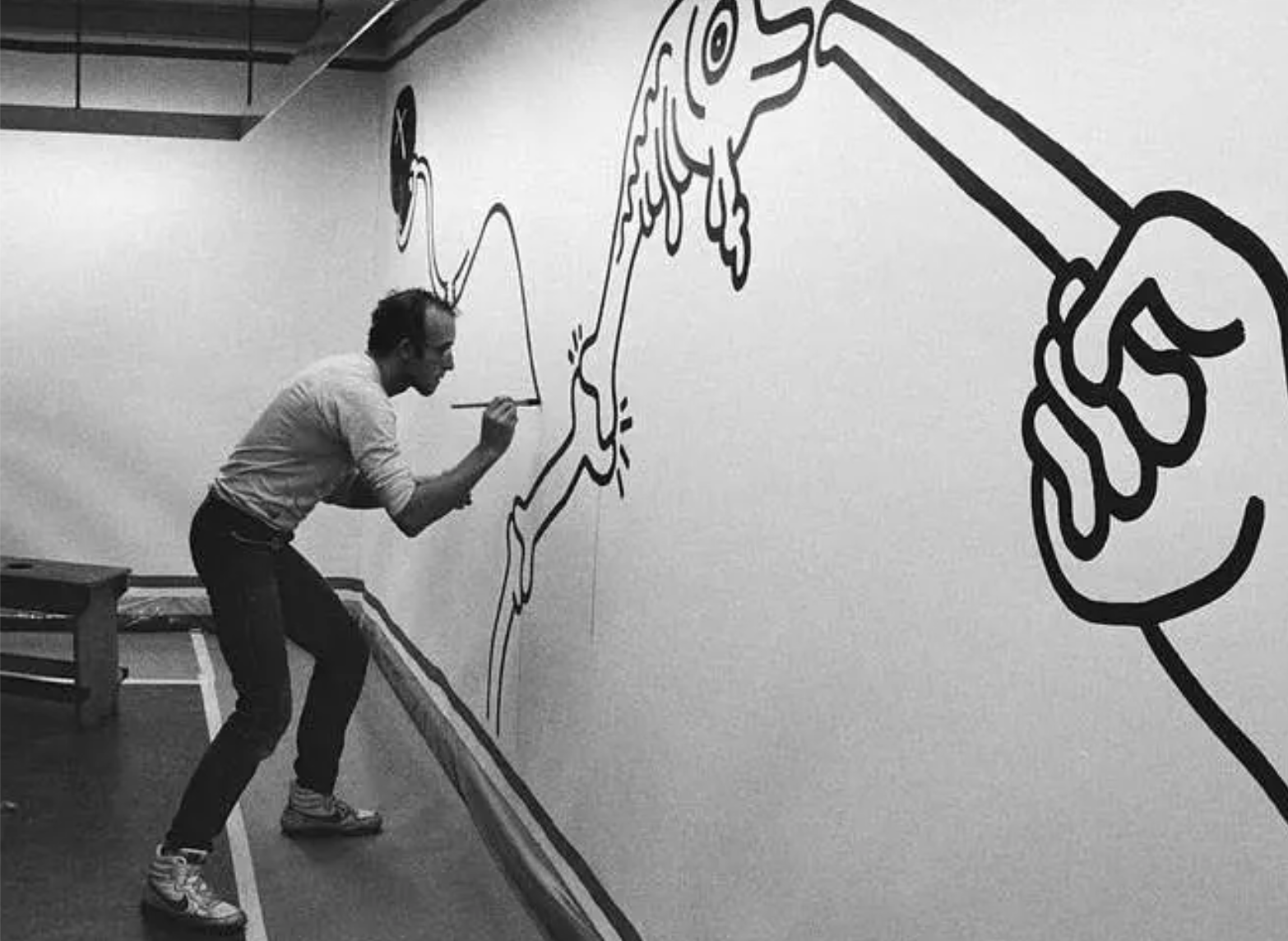
In a recent Connecticut state court dispute, an art collector sued the gallery that had sold him a Keith Haring drawing, after learning that the work’s provenance would not meet internal criteria used by Sotheby’s and Christie’s in vetting Haring works for auction.
Factual Background
At the center of the dispute is an artwork believed to be one of the so-called “subway drawings” done by the late great artist Keith Haring in the 1980s. It is estimated that Haring made as many as 5,000 of these subway drawings, which he would execute quickly in chalk on the paper hung in empty advertisement spaces on the New York City subway system. Plaintiff Vernon Adam Hartung bought his drawing, which the case dubs “the Saucer Drawing,” for $165,000 in 2018 from defendant Martin Lawrence Galleries. The invoice for the purchase included an express warranty that “any work described on the front side of this invoice which is stated without qualification to be the work of a named artist, is authentic.”
But when Mr. Hartung sought to resell the Saucer Drawing at auction in 2021, both Christie’s and Sotheby’s refused to accept it for consignment, explaining that it did not meet their internal standards for provenance; both auction houses explained that they would only accept a Haring subway drawing for auction if either there is published literature or exhibition history of the specific work, or the work appears in the Tseng Kwong Chi archive. (The Tseng Kwong Chi archive is a photographic archive created by a contemporary of Haring’s in the 1980s, and contains about 3,000 images of Haring subway drawings; while is not an exhaustive catalogue of every Haring Subway Drawing, it is generally recognized as an important reference.) Mr. Hartung’s Saucer Drawing met neither of these standards.
Mr. Hartung filed suit against Martin Lawrence Galleries and certain of its affiliates, asserting claims for, among other things, the breach of the implied warranty of merchantability.
The Court’s Decision
On August 25, 2026, following a bench trial, the Court sided with the defendants and against Mr. Hartung. Its reasoning is noteworthy for anyone interested in how the art market grapples with the complex problem of authentication.
The Court concluded that the defendants had not acted in bad faith, noting there was no evidence that, at the time of Mr. Hartung’s purchase, anyone involved in the transaction knew or had any reason to believe that Christie’s or Sotheby’s would not be willing to auction the Saucer Drawing.
Nevertheless, the Court held that the defendants had breached the sale’s “warranty of merchantability” under Article 2 of the Uniform Commercial Code (a set of laws that has been adopted, with minor variations, in almost every state, and which governs sales of goods). The Court concluded that the Saucer Drawing could not “pass without objection in the trade under the contract description.” The court based that finding on the fact that “Christie’s and Sotheby’s are significant auction houses within the market or trade of selling . . . fine art. The [Saucer D]rawing cannot pass in these markets without objection and therefore the warranty of merchantability has been breached regardless of the fault of the seller.” Ultimately, however, the court found that Mr. Hartung’s claim was brought too late, so it was dismissed on those grounds, even though the court found that it was otherwise meritorious.
As the Court recognized, “the merchantability of fine art in general . . . is inevitably dependent on its provenance.” The decision highlights the need to understand the provenance and authentication landscape for an artist and his or her body of work—preferably before a transaction, instead of discovering it years later when it’s time to resell. Mr. Hartung has initiated an appeal, and we’ll continue to monitor developments in the case.
See Hartung v. Chalk & Vermillion Fine Arts, Inc. et. al, FST CV 23-6063867-S (Conn. Super. Ct. Aug. 25, 2026).
Art Law Blog